
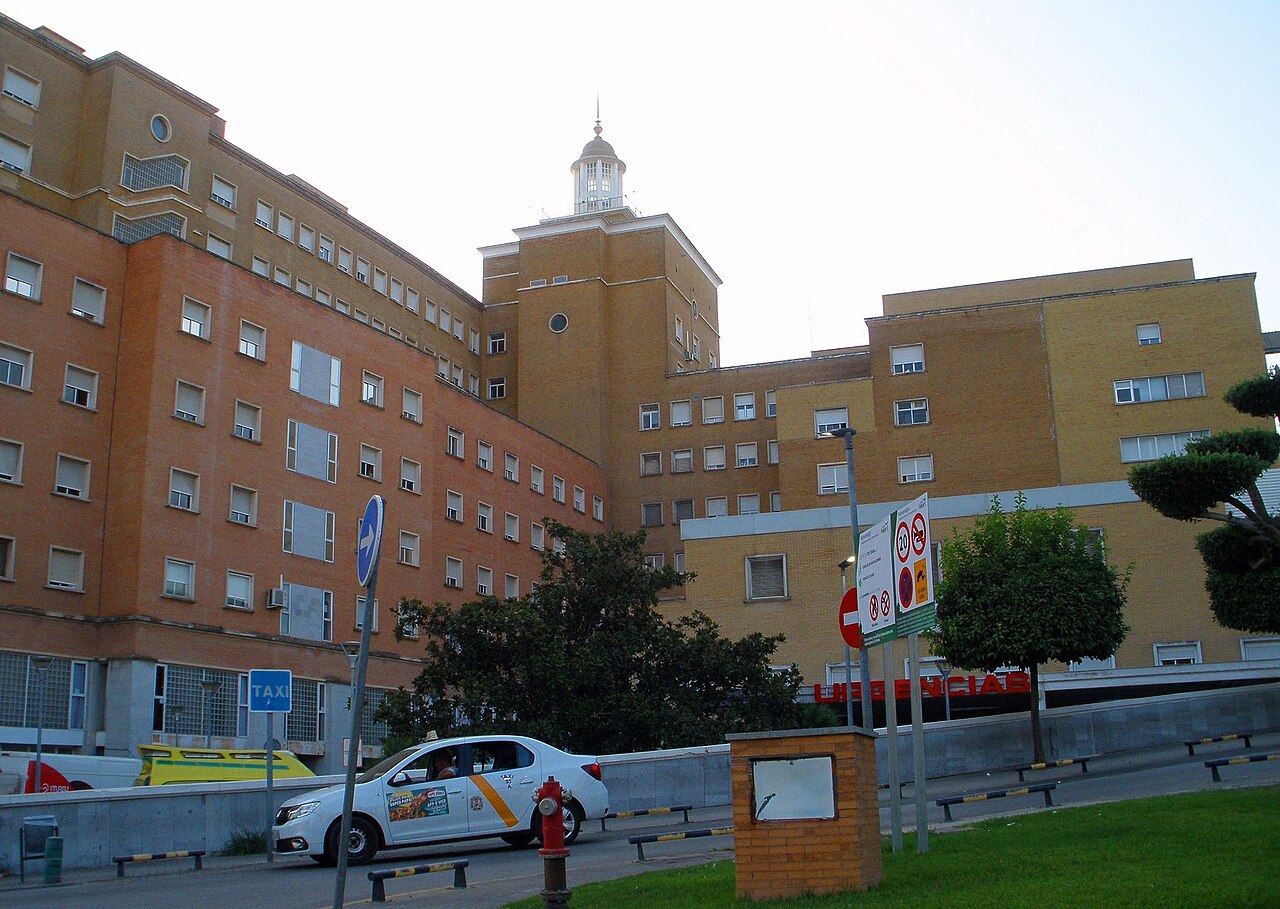
Photo: Wikimedia Commons, Public domain

Seville has good healthcare, but for newcomers the first question is usually practical: how do I see a doctor, and will they speak English? This guide explains the two routes, public and private, and what to do in an emergency.
In an emergency
- 112 is the free general emergency number for health, fire, rescue and police. Operators can usually handle calls in English.
- 061 is Andalusia’s direct line for medical emergencies, when someone’s life may be at risk.
- Salud Responde (955 545 060) is the Andalusian health service’s information line for non-urgent questions and appointments.
Urgent care is provided both at hospitals and at health centres that have an urgent care unit. For minor problems at night or at weekends, a duty pharmacy can often help too.
The public system: registering at a centro de salud
Public healthcare in Seville is run by the Servicio Andaluz de Salud (SAS). Your entry point is your local centro de salud (primary care centre), where you are assigned a family doctor (médico de familia) who refers you to specialists and hospitals when needed.
To register, the SAS asks for three things, presented at the primary care centre nearest your home together with its application form:
- Identity document: NIE or passport (DNI for Spanish nationals).
- Proof of your right to public healthcare: a document from the Social Security institute (INSS) recognising you as insured or as a beneficiary. Most people get this through their job or as a dependant.
- Proof of residence: a certificado de empadronamiento from the city council.
You then receive the Andalusian health card (tarjeta sanitaria), which also works in the Salud Andalucía app and on ClicSalud+ for booking appointments. Requirements change from time to time, so check the official SAS website before you go. Our Moving to Seville guide covers the padrón and NIE.
One thing to know: staff in the public system work in Spanish. Many doctors speak some English, but it is not guaranteed, so bring a Spanish-speaking friend or a translation app for important appointments.
Private healthcare and insurance
Many foreign residents take out private health insurance, either as their main cover or alongside the public system. Private insurers have their own networks of clinics and specialists, and their online directories often let you filter doctors by the languages they speak, which is the easiest way to find someone who consults in English. You can also pay privately for a single visit without insurance.
Before booking, check that the doctor and the hospital are included in your policy, and whether you need authorisation for tests.
Seville’s main hospitals
- Public (SAS): Virgen del Rocío, Virgen Macarena and Virgen de Valme. Which one you are assigned depends on your address.
- Private: Quirónsalud Sagrado Corazón, Quirónsalud Infanta Luisa in Triana and Viamed Santa Ángela de la Cruz.
The private groups advertise international patient services on their websites; contact them directly to ask about care in English.
Visitors and short stays
If you are visiting, bring your European Health Insurance Card (or UK GHIC) if you have one, and travel insurance that covers medical care. Keep your passport and policy number with you if you need to go to hospital.
For more practical information on health services in the city, see our Living in Seville: health section.
This guide is general information, not medical or legal advice. Rules and phone numbers can change; check the official SAS website. Spotted something out of date? Email hola@misevilla.com and we will correct it.
More guides

Best time to visit Seville: month by month weather, festivals and crowds
When to visit Seville: spring and autumn are the sweet spots, summer is fiercely hot and winter is mild and quiet. Month-by-month weather, festivals…

Itálica from Seville: how to visit the Roman city (hours, tickets and the bus)
How to visit Itálica, the Roman city on Seville's doorstep: what to see, opening hours by season, tickets, the bus from Plaza de Armas,…

Going to a football match in Seville: Sevilla FC and Real Betis tickets, stadiums and the derby
How to see Sevilla FC or Real Betis play at home: buying tickets from the official clubs, getting to the Sánchez-Pizjuán and La Cartuja,…