
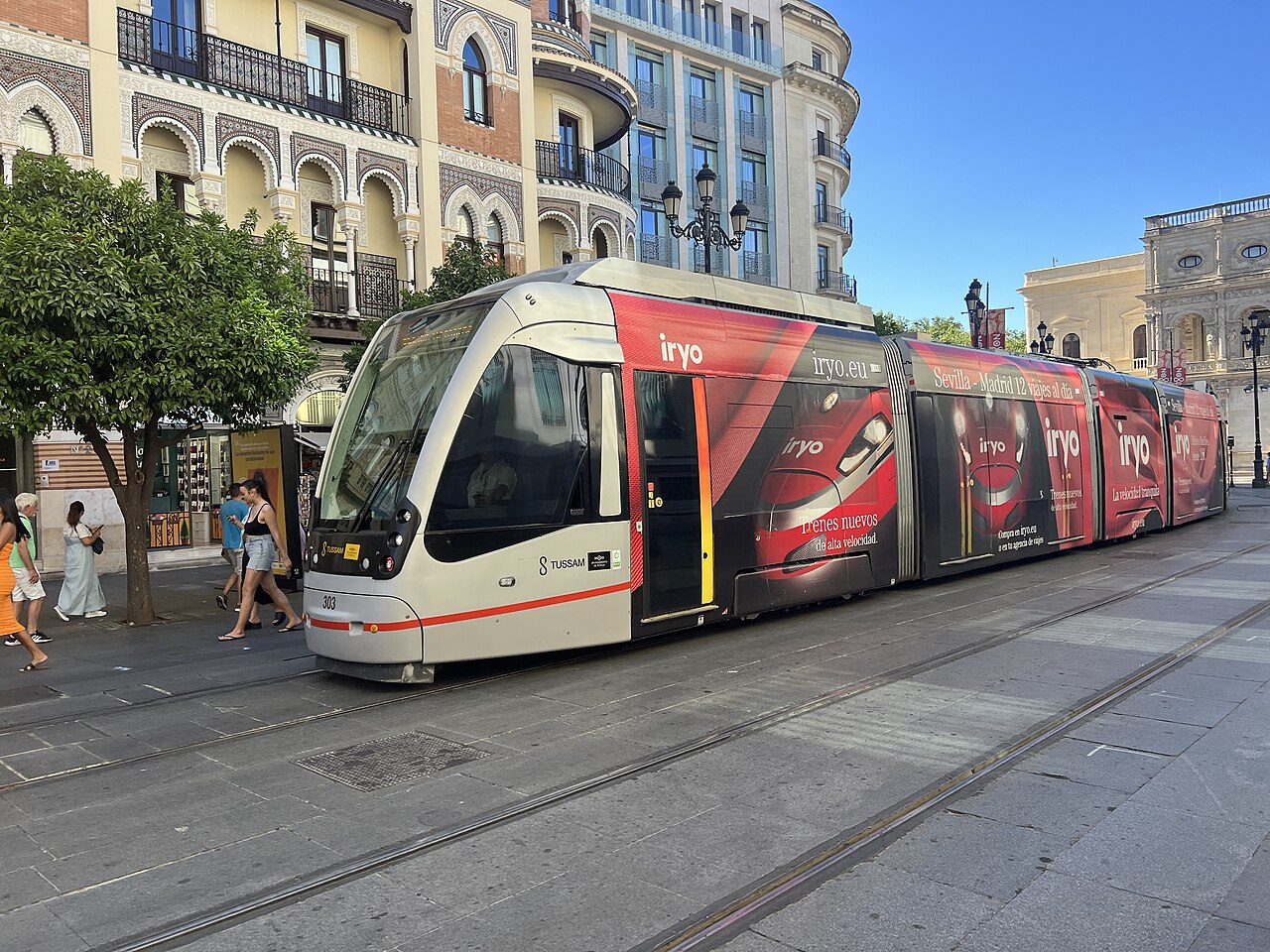
Photo: Chabe01, CC BY-SA 4.0, via Wikimedia Commons

Seville is flat and compact, so you can walk to most sights in the historic centre. For everything else there are taxis, ride-hailing apps, buses, a metro line, a tram and public bikes. Here is how each one works, with the pros and cons, so you can choose.
Taxis
Taxis are regulated by the city and charge by the meter at official rates. A free taxi shows a green light on the roof. You can hail one in the street or go to a taxi rank, marked by a blue sign with a white “T”. At the airport, Santa Justa railway station and the Plaza de Armas and Prado de San Sebastián bus stations, you must take one from the rank.
Booking a taxi by phone or online: the city’s big radio-taxi company, Teletaxi Sevilla, takes bookings on 954 62 22 22 or through its website, including rides booked in advance, and accepts card and Bizum payments.
How fares work
- There are three urban tariffs. Tarifa 1 applies on weekdays from 07:00 to 21:00. Tarifas 2 and 3 are slightly higher, for evenings, nights, weekends, public holidays, Semana Santa and the Feria.
- Under the 2026 official tariffs, Tarifa 1 has a flag fall of €1.70, then €1.16 per km, with a minimum fare of €4.62.
- Airport fixed fare: €26 on weekdays from 07:00 to 21:00 and €29 at all other times, for trips between the airport and the city.
- Small supplements apply for pickups at Santa Justa and the bus stations, and for each large suitcase over 10 kg.
- You can choose the route and ask for a receipt. Drivers only have to give change for notes up to €20.
Fares are reviewed every year, so check the current official tariffs from the Ayuntamiento de Sevilla’s Instituto del Taxi.
From the airport: taxis charge a fixed fare to the city (€26 on weekdays from 7:00 to 21:00, €29 at night, weekends and holidays). See Seville airport to the city centre for the fare details and the €6 EA bus.
Paying by card
Most Seville taxis accept bank cards and mobile payments, but it is not guaranteed, so ask “¿Puedo pagar con tarjeta?” before you set off if you have no cash.
Pros
- Official, transparent fares and licensed drivers.
- Fixed price to and from the airport.
- Easy to find at ranks or in the street, day and night.
Cons
- Can be hard to find at peak times, such as the Feria, Semana Santa, big football matches and late on Friday and Saturday nights.
- Card payment is common but not guaranteed.
Does Uber work in Seville? Uber, Cabify and taxi apps
- Uber works in Seville and lets you book licensed local taxis through the app. Check in the app which ride options are available.
- Cabify has operated in Seville since 2016 with private hire cars (VTC). It has dedicated pickup points in the airport car park, a minute’s walk from the terminal.
- FreeNow books official Seville taxis at the standard regulated fares.
- Local taxi companies also take bookings by phone, website or their own apps.
What you need to use the apps
- A smartphone with mobile data.
- An account with your email and a phone number that can receive a verification text.
- A bank card for in-app payment. Some taxi apps also let you pay the driver directly.
- You must normally be 18 or over to hold an account.
Private hire cars (VTC) are booked through an app in advance. Unlike taxis, you cannot hail them in the street.
Pros
- Price or estimate shown before you ride, and cashless payment.
- Driver name, car and plate shown in the app, plus a trip record.
- Handy if you do not speak Spanish.
Cons
- VTC prices can rise sharply at busy times, when they may cost more than a taxi.
- Needs a working phone, data and an account set up before you travel.
Private drivers and transfers
Licensed private-hire companies offer chauffeur services and airport or station transfers that you book in advance, often with a driver waiting for you with your name on a sign. They suit families with lots of luggage, groups and early or late flights.
Pros
- Fixed price agreed in advance.
- Driver waiting on arrival and space for luggage.
- Larger vehicles available for groups.
Cons
- Usually more expensive than a taxi for one or two people.
- Must be booked ahead. Use a licensed company, not an unofficial driver.
Buses (TUSSAM)
TUSSAM, the city bus company, runs an extensive network across Seville. Under the 2026 fares, a single ticket costs €1.40.
- Contactless bank card: since June 2024 you can pay a single fare by tapping your bank card on the validator on board.
- Cash: you can also buy a single ticket from the driver. Use small change.
- Rechargeable cards: regular riders save a lot with the rechargeable multi-trip card (tarjeta multiviaje), which costs much less per journey. The bank-card fare does not include this discount.
- Airport bus (line EA): links the airport with the city centre and Santa Justa. Under the 2026 fares it costs €6 one way or €8 return.
- The official TUSSAM app shows lines, stops and expected arrival times. Many stops also have electronic displays.
Pros
- Cheap, frequent and covers the whole city.
- Pay with a bank card, with no ticket needed in advance.
Cons
- Slower in traffic.
- Routes change during Semana Santa and the Feria, when many central streets close.
- The best discounts need a rechargeable card.
Metro and tram
- Metro line 1 crosses the city from the Aljarafe in the west to Montequinto in the south-east, passing Puerta de Jerez, San Bernardo and Nervión. It is fast and air-conditioned, and you can pay at the gates with a contactless bank card.
- The tram (Metrocentro) is a short line through the centre, from Plaza Nueva along Avenida de la Constitución to San Bernardo station.
Pros
- Fast and reliable, unaffected by traffic.
- Good links to train and bus stations.
Cons
- Limited network: one metro line and a short tram line.
- Many sights are a walk from the nearest stop.
Bikes and walking
Seville has an extensive network of bike lanes and a public bike-share scheme, Sevici, with stations all over the city. Walking is often the quickest way around the historic centre, where many streets are narrow or pedestrianised.
Pros
- Free or cheap, healthy, and the best way to discover the city.
- The city is completely flat.
Cons
- Very hot from June to September, so ride or walk early or late.
- Watch out for cobbles and narrow lanes in Santa Cruz.
Google Maps or official apps?
Google Maps is very useful for walking routes and for planning journeys on buses, metro and tram. Its times are estimates, based on timetables and typical traffic, so treat them as a guide. Bus times in particular can vary at rush hour.
- For live bus arrivals, use the official TUSSAM app or the displays at stops.
- During Semana Santa and the Feria, many central streets close and buses are diverted. Apps may not show the changes, so check TUSSAM’s official notices.
- Walking times in the old town are usually accurate, and often faster than any vehicle.
Arriving by plane? See day trips from Seville for trains and buses beyond the city, and our things to do guide.
Thinking of hiring a car? Read is it worth renting a car in Seville?
Living here? Read Seville by bike and e-scooter: the bike lanes, the rules and Sevici.
Prices and services change, so check the official websites: Ayuntamiento de Sevilla (taxi tariffs), TUSSAM, Metro de Sevilla and the app providers. Spotted something out of date? Write to hola@misevilla.com.
More guides

Seville on a Budget: How to Enjoy the City Without Overspending
Practical tips for visiting Seville on a budget: when to come, where to stay, eating well for less, free sights, cheap transport and the…

Empadronamiento in Seville: How to Register on the Padrón (and Keep It Valid)
How to register your address on Seville's padrón: booking the appointment, the documents you need, volante vs certificado, moving flat, renewals for non-EU residents…

Santa Cruz, Seville: a neighbourhood guide to the old Jewish quarter
How to explore Santa Cruz, Seville's old Jewish quarter: its history, the squares and lanes worth finding, when to go to avoid the crowds,…