
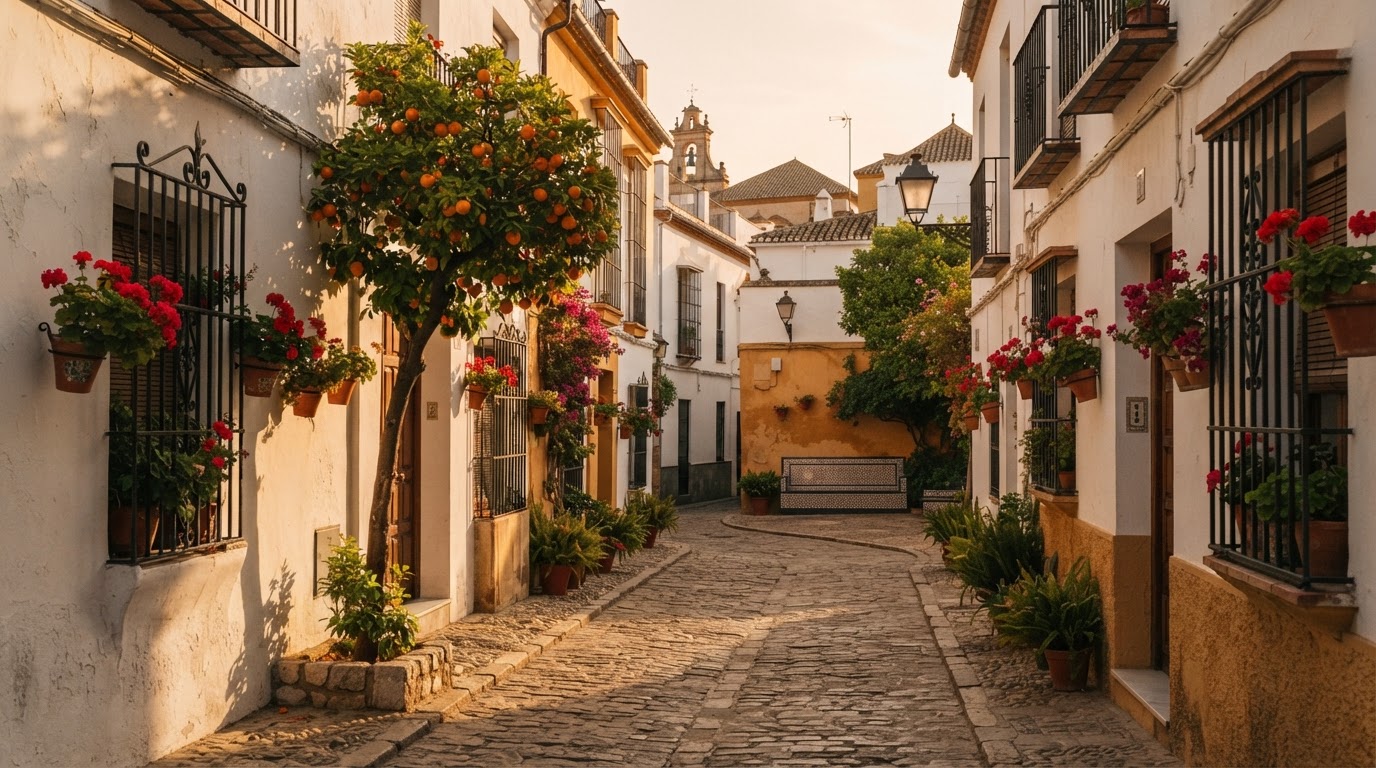
AI illustration

Santa Cruz is the maze of whitewashed lanes, tiny squares and orange trees tucked between the Cathedral, the Real Alcázar and the Murillo Gardens. It is the Seville of postcards, and it really is beautiful, but it is also the busiest corner of the city. This guide explains where it came from, what to look for, and how to enjoy it without being swept along by tour groups.
A short history
After the Christian conquest of Seville in 1248, this area became the city’s Jewish quarter, the judería, walled off from the rest of town. It was devastated in the anti-Jewish riots of 1391, and its synagogues were later turned into churches. Much of the picturesque look you see today is more recent than it seems: the quarter was tidied up and partly rebuilt in the early twentieth century, around the time Seville was preparing for the 1929 Ibero-American Exposition, which is when many of its gardens, tiled benches and fountains appeared.
What to find
- Patio de Banderas. A free, open square inside the Alcázar precinct with one of the best framed views of the Giralda. Walk through its arch and you are at the edge of the quarter.
- Callejón del Agua. A lane running along the outer wall of the Alcázar gardens, named after the water channels that once ran inside the wall. It leads towards the Murillo Gardens.
- Plaza de Santa Cruz. The square that gives the quarter its name. The parish church that stood here was demolished during the French occupation in the early 1800s, and the painter Murillo, who was buried in it, has no known grave as a result. An ornate wrought-iron cross now stands in the middle.
- Plaza de Doña Elvira and Calle Vida. A small square with tiled benches and orange trees, and one of the narrowest lanes in the quarter leading off it.
- Calle Susona. A short street tied to one of Seville’s best-known legends, about a young woman from the Jewish quarter in the fifteenth century; a tile plaque tells the story.
- Plaza de los Refinadores. A quiet square with a statue of Don Juan Tenorio, the fictional Sevillian seducer of Spanish theatre.
- Hospital de los Venerables. A seventeenth-century Baroque building founded as a home for elderly priests, with a beautiful patio and church. It is now home to the Focus foundation and the Velázquez Centre; check opening times and tickets on its official website (hospitalvenerables.es).
- Jardines de Murillo. The shady gardens on the quarter’s southern edge, with the monument to Columbus and a good place to sit after the lanes.
When to go
Early morning, before about 10:00, is when Santa Cruz feels most like a neighbourhood: delivery vans, people walking to work, the squares almost empty. From late morning to mid-afternoon the main lanes fill with guided groups heading to and from the Alcázar. Evenings are lovely again, especially after sunset when the lamps come on. In summer, the shaded lanes are cooler than the open avenues, but avoid the hottest hours; our Seville in summer guide has more on that.
The streets are mostly closed to traffic and many are too narrow for anything wider than a bicycle. Wear flat shoes for the cobbles. The nearest tram stops are Archivo de Indias and Puerta de Jerez, which is also the nearest metro station.
Pairing it with the big sights
Santa Cruz wraps around the Real Alcázar and sits beside the Cathedral, so most visitors combine them. Book timed tickets in advance (see our guides to Alcázar tickets and Cathedral and Giralda tickets) and use the quarter as the walk in between. A good order: Alcázar first thing, lunch in or around Santa Cruz, a slow wander through the lanes, then the Cathedral in the afternoon.
Eating and drinking
The squares right beside the Cathedral and the Alcázar are lined with terraces aimed at visitors; they are convenient but rarely the best value. Walk a few streets further in, or towards Calle Mateos Gago and the Puerta de la Carne side of the quarter, and you will find more locals. A few places in our directory around here: Bendala Brasería, a charcoal grill facing the Murillo Gardens; La Taraceína on Calle Puerta de la Carne; and Naturalmente Real Food, a healthy brunch-and-lunch spot. For a drink with a view of the Cathedral, try La Terraza del EME or Terraza Doña María. If you want to switch off for an hour, AIRE Ancient Baths is on the edge of the quarter. More ideas in what to eat in Seville.
Staying in Santa Cruz
Sleeping here puts you a few minutes’ walk from the main sights, and the lanes are magical late at night once the day-trippers have gone. The downsides: taxis often cannot reach your door, rooms in old houses can be small, and some streets stay noisy until late. Our where to stay in Seville guide compares it with Triana, the Arenal and other areas, and the Stay section lists hotels and hostels here.
Honest verdict
Santa Cruz deserves its fame, but the real pleasure is in getting a little lost rather than ticking off a list. Go early or late, leave the map in your pocket for half an hour, and stop in whichever small square is quietest. If you have more time, cross the river to Triana for a very different side of the city.
Spotted something out of date or wrong? Tell us at hola@misevilla.com and we’ll fix it.
More guides

What’s on in Seville: 16–25 November 2026
The best of Seville this week: the Seville derby, Javier Perianes at the Maestranza, Lorca's El Público at the Lope de Vega, Gemeliers, OBK…

Triana, Seville: a neighbourhood guide to the other side of the river
How to explore Triana, Seville's riverside barrio of potters, sailors and flamenco: the bridge and Calle Betis, the market and castle, ceramics, churches, tapas…

English-language films in Seville: where to see movies in English (VOSE) and how to buy the right ticket
Most films in Spanish cinemas are dubbed. Here's how to find English-language screenings in Seville, what VOSE, VOS and VO mean on the listings,…