
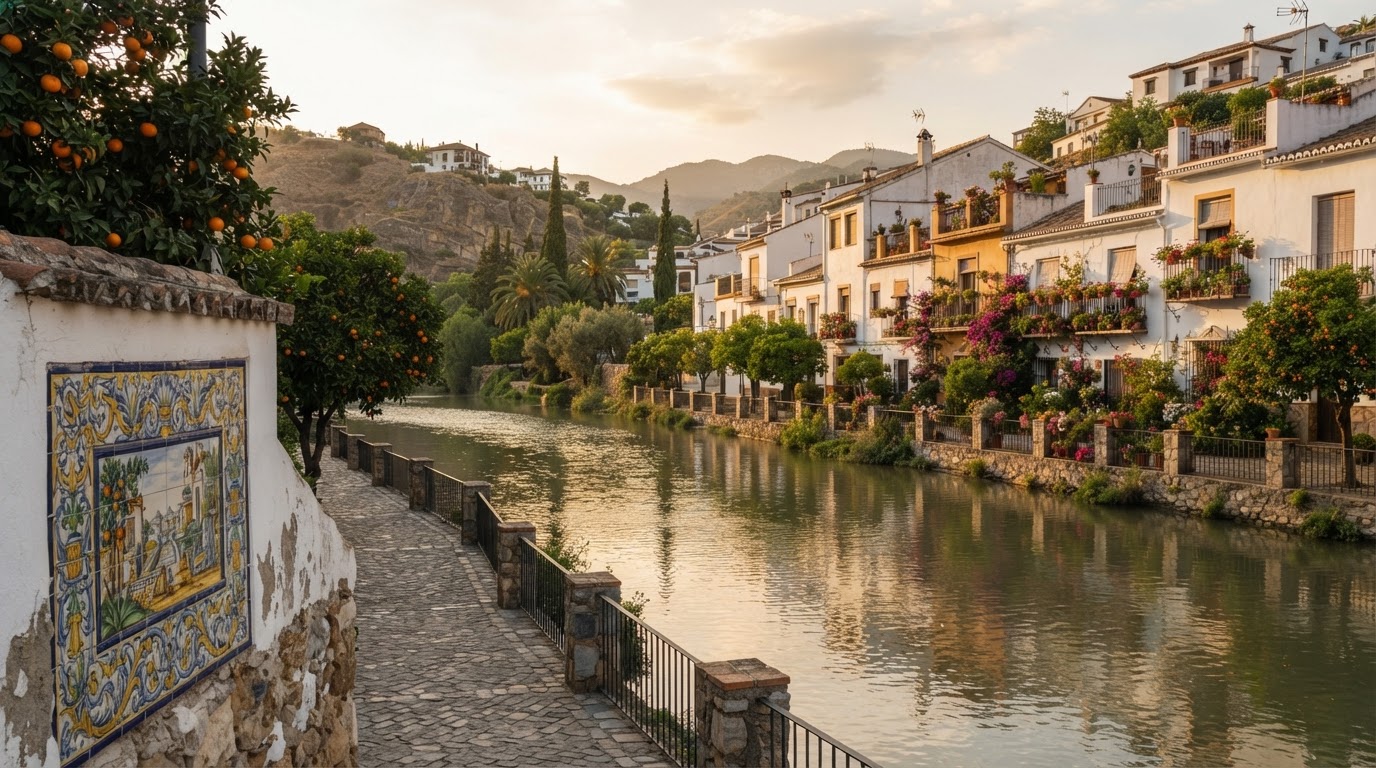
AI illustration
Cross the river from the old town and you’re in Triana, the barrio that sevillanos of every other neighbourhood half-jokingly treat as a separate republic. For centuries it was home to sailors, potters, tile makers and flamenco families, and it still feels like a place where people live rather than a stage set. It’s compact, flat and easy to explore on foot in a morning, though most people end up staying for lunch, and then for dinner.
Getting there
The classic way in is on foot over the Puente de Isabel II, which everyone simply calls the Triana bridge, about ten minutes’ walk from Plaza Nueva or the Torre del Oro. The other approach is from the south via the Puente de San Telmo and Plaza de Cuba, where there’s a metro stop on Line 1. Buses also cross from the centre; see our getting around guide. Driving in is not worth it: parking is tight, though there is an underground car park by the market (Parking Mercado de Triana).
The river front: the bridge and Calle Betis
The iron Triana bridge, opened in the mid-19th century to replace an old bridge of boats, was Seville’s first permanent crossing of the Guadalquivir and is one of the city’s best-loved landmarks. Stop in the middle for the view of the river and the Torre del Oro. On the far side, the little chapel on the bridgehead and the Plaza del Altozano mark the entrance to the barrio.
Turn left along Calle Betis, the row of colourful houses facing the old town across the water. This is the postcard view of Triana, and the riverside wall below is one of the city’s favourite spots to sit at sunset. Calle Betis is lined with bars and terraces; it gets lively at night and at weekends.
Triana Market and the Castillo de San Jorge
Right by the bridge stands Triana Market, a working food market with fish, meat, fruit and vegetable stalls alongside small tapas counters, so you can shop and snack under one roof. Mornings are best, when the stalls are in full swing. There’s even a cooking school inside if you want to learn to make Andalusian classics.
The market was built on the ruins of the Castillo de San Jorge, a medieval castle that from 1481 served as the headquarters and prison of the Spanish Inquisition in Seville. Today the excavated remains under the market house a sober, well-presented interpretation centre run by the city. It’s one of the most thought-provoking visits in Seville and doesn’t take long.
Ceramics: Triana’s trade
Many of the painted tiles you see all over Seville were made in Triana. The Centro Cerámica Triana, a museum set in the old Santa Ana pottery factory on Calle Antillano Campos, keeps the original kilns, wells and workshops and explains how the barrio’s clay industry worked for centuries. In recent years the Real Alcázar’s general ticket has included a visit to the Centro Cerámica Triana within a set period, so keep your Alcázar ticket and check the current conditions when you buy it.
Afterwards, wander the streets around Calle Alfarería and Calle San Jorge, where a handful of ceramics workshops and shops still sell hand-painted tiles, plates and house-number plaques. They make some of the best souvenirs you can take home from Seville.
Churches and devotion
Triana’s oldest church, Santa Ana, dates back to the 13th century, just after the Christian conquest of Seville, and locals call it the “cathedral of Triana”. On Calle Pureza, the Capilla de los Marineros is home to the Esperanza de Triana, one of the most venerated images of Holy Week; the night she processes is one of the great moments of Semana Santa. Both are small and easy to visit if you find them open; dress respectfully.
Flamenco roots
Triana is one of the cradles of flamenco. Generations of singers, dancers and guitarists grew up in its “corrales de vecinos”, communal courtyard houses where families shared a patio. You’ll see tile plaques honouring famous artists on house fronts as you walk. For a show tonight, see our guide to the best flamenco shows in Seville.
Eating and drinking
Triana is one of the best places in Seville to eat. Calle San Jacinto, the pedestrian street running from the Altozano, and Calle Pureza and the streets behind are full of tapas bars where locals actually eat. Our guide to the best tapas in Triana picks out favourites. A few sit-down options in the directory: Jaylu for top-end seafood, Balbuena y Huertas for relaxed Andalusian cooking on San Jacinto, and Ántica Roma if you fancy a Roman-style plate of pasta.
When to go
- Mornings: the market, the castle and the ceramics centre, before the heat in summer.
- Sunset: the riverbank below Calle Betis and the bridge, with the old town lit up opposite.
- July: the Velá de Santa Ana, Triana’s traditional summer fair along the river, with stalls, music and festivities.
- Holy Week: the processions of Triana’s brotherhoods crossing the bridge are unforgettable, and very crowded.
Staying in Triana
Triana is a good base if you want a neighbourhood feel within walking distance of the sights: it’s quieter than Santa Cruz at night, with plenty of places to eat on your doorstep. Browse places to stay or read our guide on where to stay in Seville.
Spotted something out of date or missing? Tell us at hola@misevilla.com and we’ll fix it.
More guides

Seville on a Budget: How to Enjoy the City Without Overspending
Practical tips for visiting Seville on a budget: when to come, where to stay, eating well for less, free sights, cheap transport and the…

Empadronamiento in Seville: How to Register on the Padrón (and Keep It Valid)
How to register your address on Seville's padrón: booking the appointment, the documents you need, volante vs certificado, moving flat, renewals for non-EU residents…

Santa Cruz, Seville: a neighbourhood guide to the old Jewish quarter
How to explore Santa Cruz, Seville's old Jewish quarter: its history, the squares and lanes worth finding, when to go to avoid the crowds,…