
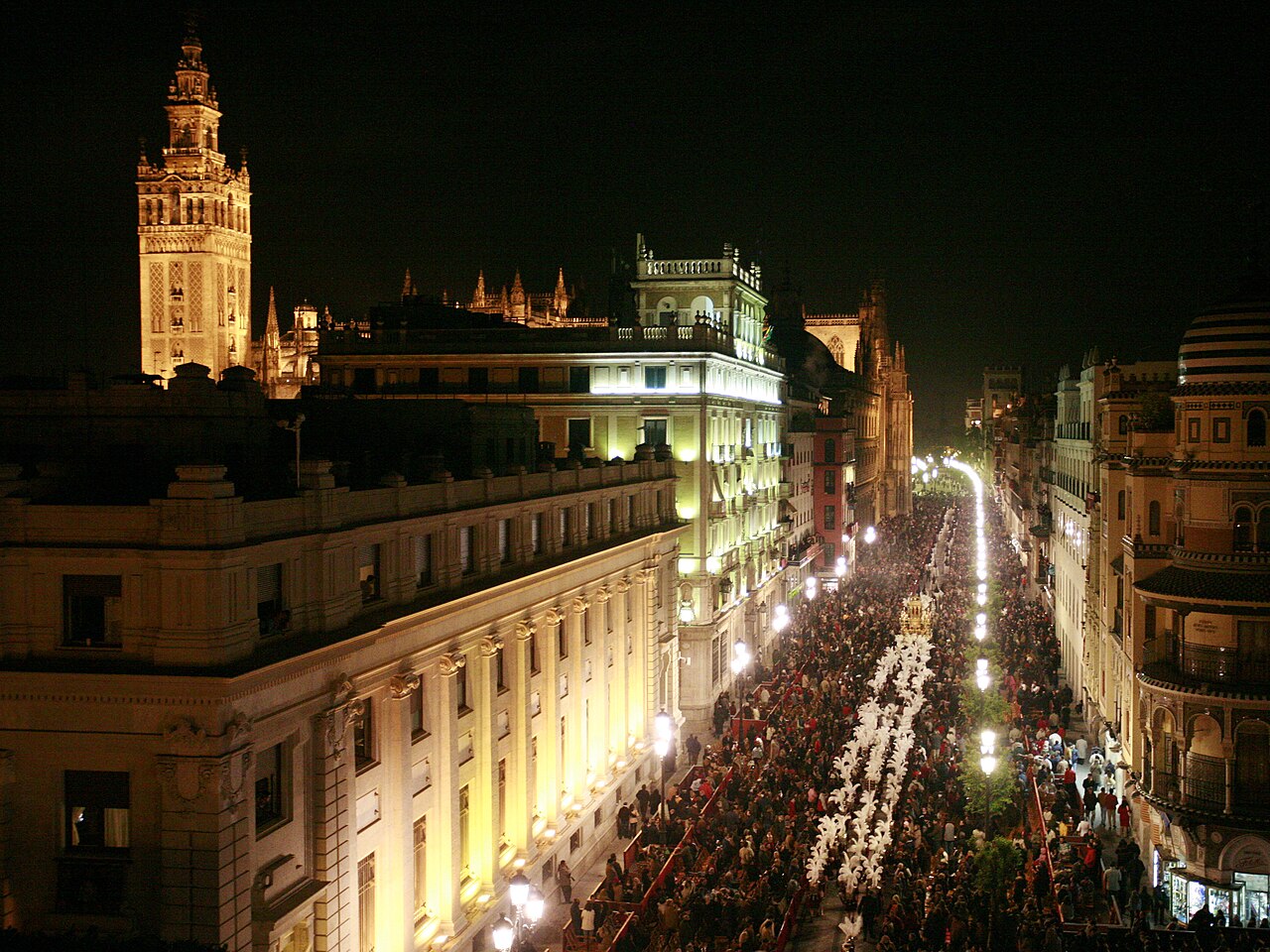
Photo: Sevilla Congress & Convention Bureau, CC BY-SA 2.0, via Wikimedia Commons

Holy Week (Semana Santa) is Seville’s most important celebration. For eight days, dozens of religious brotherhoods carry ornate floats through the streets, accompanied by thousands of hooded penitents, marching bands and huge crowds. It is moving, spectacular and unlike anything else in Spain. In 2027, Semana Santa runs from Palm Sunday, 21 March, to Easter Sunday, 28 March.
How the processions work
Each procession belongs to a hermandad or cofradía (brotherhood), usually based in a parish church. On its assigned day, the brotherhood leaves its church and walks to the cathedral and back, a journey that can take many hours. Most processions carry two pasos (floats): one with a scene of the Passion of Christ and one with the Virgin Mary under a canopy. The floats are carried from underneath by teams of costaleros, who cannot see where they are going and follow the commands of the capataz.
In front of the floats walk the nazarenos, penitents in long robes and pointed hoods. The hoods are a centuries-old penitential tradition and have no connection with any other organisation. Bands play solemn marches, and from time to time someone on a balcony sings a saeta, an unaccompanied flamenco-style prayer.
Key days
- Palm Sunday (Domingo de Ramos): a festive start, with many children taking part.
- Holy Monday to Wednesday: busy days with several processions each, a good time to watch with smaller crowds.
- Maundy Thursday (Jueves Santo): a solemn day, when many locals dress formally to visit the churches.
- La Madrugá: the night of Thursday into Good Friday, the emotional peak of the week, when some of the most venerated images, including the Macarena and the Gran Poder, are on the streets until morning. Crowds are enormous.
- Good Friday, Holy Saturday and Easter Sunday: the processions continue, ending with the Resurrection on Sunday morning.
Where to watch
Every brotherhood passes through the carrera oficial, the official route in the centre leading to the cathedral, where seating is sold to local season-ticket holders. For visitors, the best experiences are often away from the official route: watch a procession leave or return to its own church, or find it in a narrow street where the floats almost touch the balconies. Brotherhoods publish their itineraries and timetables before the week, and local apps and newspapers carry them too.
Some of the most memorable moments happen near the brotherhoods’ own neighbourhoods, such as Triana, where processions cross the Isabel II bridge, and La Macarena, near the Basílica de la Macarena.
Etiquette
- Never cross through a procession. Wait for a gap, or follow the stewards’ directions.
- Keep quiet during the most solemn moments, especially when a float stops.
- Avoid using flash photography directly at the nazarenos and floats.
- Do not sit or stand on the route in a way that blocks people who have been waiting longer.
Practical tips
- Book accommodation very early. Hotels fill up months ahead and prices rise sharply.
- Expect the centre to be crowded and partly closed. Streets on the route fill up hours in advance, and getting across the centre can take a long time.
- Rain matters. If rain is forecast, brotherhoods may delay or cancel their procession to protect the floats.
- Children: the daytime processions earlier in the week are the most family friendly. Agree a meeting point in case you get separated.
- Try torrijas, the traditional Holy Week sweet, in local bakeries.
After Semana Santa
About two weeks after Easter, the city changes mood completely for the Feria de Abril. For other ideas, see our guide to the best things to do in Seville.
Timetables and routes are set by the brotherhoods and the Consejo de Cofradías each year. Check the official programme before you plan your days. Spotted something out of date? Email hola@misevilla.com.
More guides

Seville on a Budget: How to Enjoy the City Without Overspending
Practical tips for visiting Seville on a budget: when to come, where to stay, eating well for less, free sights, cheap transport and the…

Empadronamiento in Seville: How to Register on the Padrón (and Keep It Valid)
How to register your address on Seville's padrón: booking the appointment, the documents you need, volante vs certificado, moving flat, renewals for non-EU residents…

Santa Cruz, Seville: a neighbourhood guide to the old Jewish quarter
How to explore Santa Cruz, Seville's old Jewish quarter: its history, the squares and lanes worth finding, when to go to avoid the crowds,…