
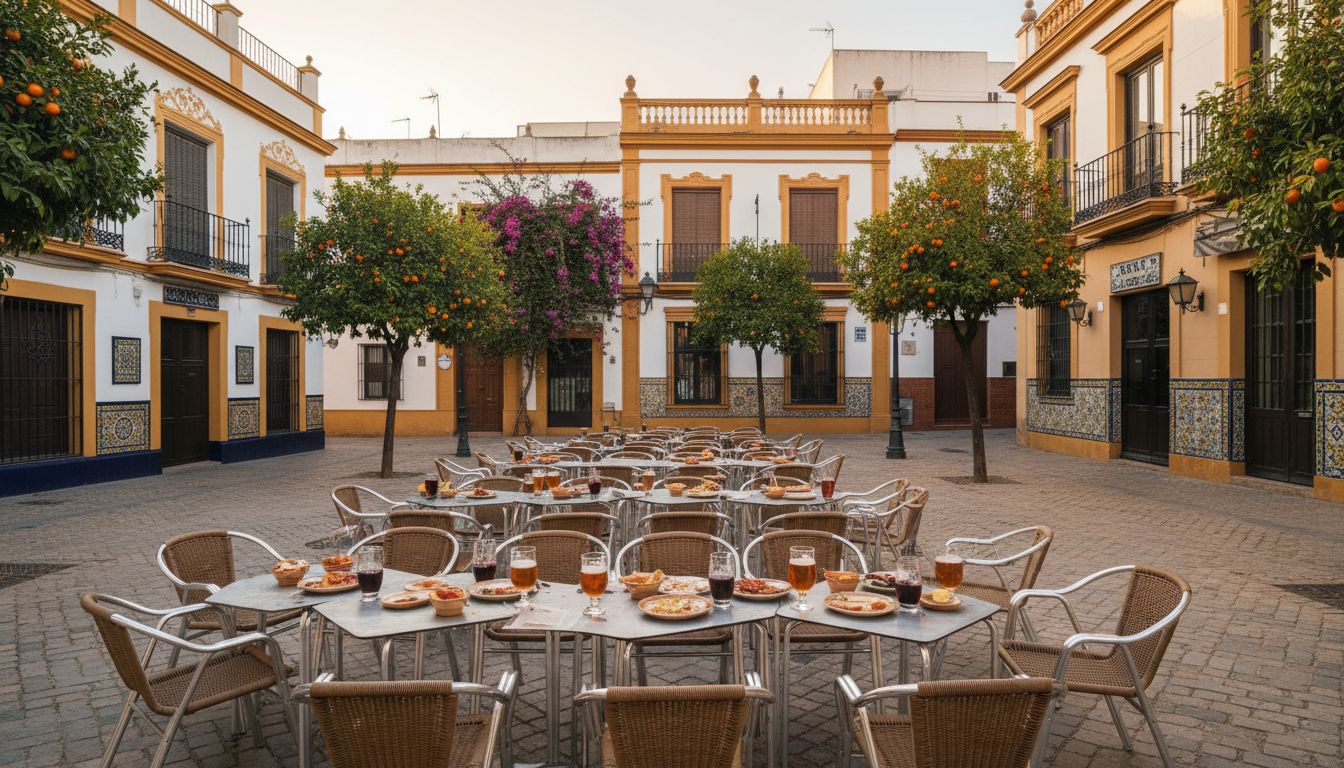
AI illustration
Seville is one of the easiest cities in Spain to chat with strangers and one of the slower ones to turn those chats into real friendships. Both things are true at once, and knowing that from the start saves a lot of disappointment. This guide is for anyone who has moved here, or is about to, and wants a social life that includes Spanish people, not only other newcomers.
What to expect: warm on the surface, loyal underneath
Social life here happens outside the home: on bar terraces, in plazas, at the market, on long Sunday lunches. People talk easily, bars are noisy and friendly, and you’ll often be drawn into a conversation at the counter. That openness is real, but it is not the same as being invited into someone’s circle.
Many Sevillanos have the same group of friends, their pandilla, since school or university, and see their extended family every week. Their social calendar is often already full. It is rarely about you; it is simply that there is less obvious space for someone new. Invitations to someone’s home tend to come later than in the US or Latin America, and plans can be loose: “a ver si quedamos” (let’s try to meet up) is friendly, but it is not yet a date in the diary.
Where newcomers usually fit in easily
- Anything with a shared activity. A weekly class, team or project gives you a reason to see the same people again and again, which is how friendships form here.
- Neighbourhood life. Going to the same café, market stall or bar regularly turns you into a familiar face surprisingly fast. Learn names and say hello.
- Families with children. School gates, birthday parties and parks are some of the quickest routes into local circles. See our guides on helping children adapt and parks and playgrounds.
- Food and fiestas. Showing genuine curiosity about local food, flamenco and the city’s festivals opens a lot of conversations.
Where you may feel a bit lost at first
- Fast Andalusian Spanish. Even fluent speakers need time to tune in to dropped consonants and quick group conversation. It gets much easier after a few months.
- The Feria. Most casetas at the April Fair are private, so the week is far more fun once you know people who have one. Our Feria guide explains how it works.
- Semana Santa and the hermandades. Holy Week is central to many Sevillanos’ lives and identity. Watch with respect, ask questions, and you’ll learn a lot about the people around you. See our Semana Santa guide.
- The timetable. Late lunches, late dinners and evenings that start after 21:00 can feel tiring at first. Most people adjust within a season.
Practical ways to meet Spanish people
Language exchanges (intercambios)
Seville has plenty of locals who want to practise English, so language exchanges are an easy first step. They usually meet in a bar in the evening, and many people come back week after week. Treat them as a starting point: swap numbers with the people you click with and suggest something outside the exchange, like a walk or a tapas evening. Language schools are another option, and some run their own social activities; browse Living in Seville for listings.
The city’s own workshops (talleres socioculturales)
Each district of the Ayuntamiento de Sevilla runs a programme of low-cost or free talleres socioculturales, from painting and pottery to dance, music and cooking, held in civic centres across the city. Registration opens in September, through the city council’s website and the district offices, and classes run through the school year. They are full of local neighbours, which makes them one of the best places to practise everyday Spanish.
Sport
The city’s sports institute, the Instituto Municipal de Deportes (IMD), runs municipal sports centres with courses and pools, plus amateur competitions such as the Juegos Deportivos Municipales. Padel is hugely popular, and joining a club ladder or a regular group is a classic way to meet people. Running groups, cycling clubs and rowing on the Guadalquivir are other good options.
Volunteering
Volunteering puts you next to people who care about the same things you do. Seville has a large network of social organisations, coordinated in part by the Plataforma del Voluntariado Social de Sevilla, and long-established charities such as Cáritas and the city’s food bank regularly look for help. If you study at the Universidad de Sevilla or Pablo de Olavide, both universities have volunteering offices.
Flamenco, music and peñas
Taking a flamenco, sevillanas or guitar class gives you a weekly group and a way into local culture; sevillanas classes are especially popular before the Feria. Flamenco peñas, the small members’ clubs that host recitals, are friendly places once you become a regular. Our flamenco guide explains the different venues.
Hermandades and parishes
The hermandades are Catholic brotherhoods, and joining one is a religious commitment, not a social club. If you are Catholic, or simply interested, many have youth groups and charity projects, and some welcome volunteers for their social work. Approach them with respect for what they mean to their members.
Small habits that make a big difference
- Say yes. Accept invitations, even casual ones, and turn up. Being reliably present matters more than being impressive.
- Make the plan concrete. Turn “we should meet” into “Thursday at 20:30 at that bar on the plaza?”
- Keep showing up. Friendships here grow through repetition: the same class, the same bar, the same group.
- Speak Spanish, even badly. People really appreciate the effort, and conversations go deeper.
- Share your own culture. Cook your home food for new friends; it is a lovely way to return hospitality.
- Keep your international friends too. They are not a failure to integrate. They are your support while the rest grows.
Give it time, and enjoy the process
Many newcomers say the first year feels slow and the second feels completely different. Once a Sevillano counts you as a friend, that friendship tends to be warm, generous and long-lasting. In the meantime, the city itself is good company: long walks, sunny terraces and a calendar full of fiestas make it easy to enjoy the journey. If you are just arriving, our guides to moving to Seville and moving from Latin America or the US cover the practical side.
Sources: Ayuntamiento de Sevilla (Talleres Socioculturales; Instituto Municipal de Deportes), Universidad de Sevilla, Universidad Pablo de Olavide.
Spotted something out of date, or have a tip for making friends in Seville? Write to us at hola@misevilla.com.
More guides

Seville on a Budget: How to Enjoy the City Without Overspending
Practical tips for visiting Seville on a budget: when to come, where to stay, eating well for less, free sights, cheap transport and the…

Empadronamiento in Seville: How to Register on the Padrón (and Keep It Valid)
How to register your address on Seville's padrón: booking the appointment, the documents you need, volante vs certificado, moving flat, renewals for non-EU residents…

Santa Cruz, Seville: a neighbourhood guide to the old Jewish quarter
How to explore Santa Cruz, Seville's old Jewish quarter: its history, the squares and lanes worth finding, when to go to avoid the crowds,…